


Why health AI needs trust built into workflows
In health systems in low- and middle-income countries, technology can travel faster than trust. Digital literacy, accountable follow-up, and local ownership decide whether AI becomes a trusted component of care.
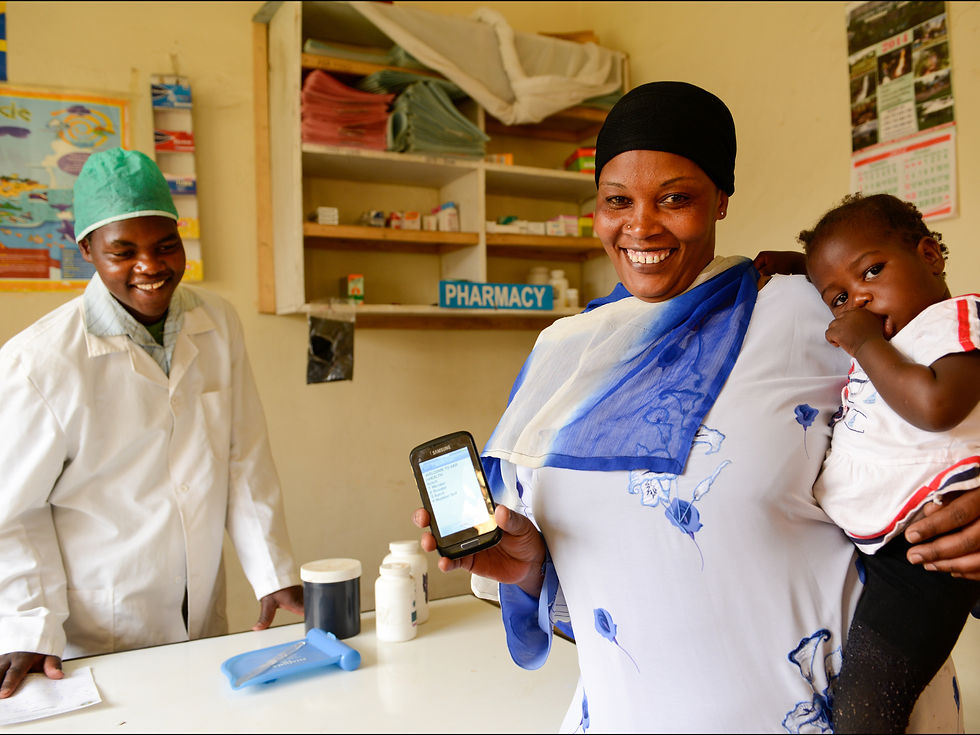
Digital health earns trust when it works where care happens, like this mobile health service for the PharmAccess mHealth programme in an African clinic. Photo: Elmvh, via Wikimedia Commons
Across our work designing AI-enabled primary care programmes with health system partners in South Asia, Africa, and in other low- and middle-income countries (LMICs), the same pattern keeps emerging. A conversation may begin with model accuracy, interoperability, or scale, but it soon moves to the questions that decide whether technology will be used: who explains the result? Can a frontline worker challenge it? Where does the data travel? Who owns follow-up when a patient leaves?
These questions matter where digitalisation lands inside systems already managing workforce shortages, fragmented records, variable connectivity, and long journeys to access care. But low resource must not be confused with low capability. Communities and frontline teams often know exactly where a workflow will break. Yet, too often, programmes seek their input only after a solution has already been deployed.
One field programme changed our question
Our largest completed field programme is Project Phoenix in Uttar Pradesh, India. It combines community screening, AI-assisted risk identification, telemedicine, and digital follow-up. Across more than 30 field camps, the programme screened over 10,000 people, trained more than 200 frontline workers, enabled over 1,800 calls with healthcare professionals, and reached more than 90% of its intended coverage.
Its research-led model also carried field learning beyond the programme. The Research Interest Score on ResearchGate—an indicator combining reads, citations, and recommendations—stood at 660.1; the work received more than 37,000 reads and reached audiences in over 74 countries. These are not measures of clinical impact, but they show that the field lessons reached researchers and practitioners far beyond the programme. At the camps, the tool could flag within minutes that a participant's screening data might require clinical review. It was a prompt for a health worker, not a diagnosis.
The harder work began after the screen had done its job.
A screening flag created questions no model could answer. Would a family hear “risk” or “diagnosis”? Which clinician would receive the referral? Could the person travel? Who would call if they did not return? The people who made the technology usable were the frontline workers who translated a score into a conversation and knew which local clinician might respond. People trusted a person they already knew, who happened to be holding a digital tool.
Around 30% of participants entered follow-up pathways, including phone or in-person consultations with healthcare professionals, referrals for further assessment, and continued monitoring according to need. That figure shifted our question from how many risks a tool could identify to how reliably the system could carry a person from screening to care. The gap was not a footnote to implementation; it was the implementation.
Trust must be built within each health system
This lesson now shapes our proposed county-level pilot design in Kakamega, Kenya. We did not begin with a catalogue of AI products. We began by mapping how community health promoters, facilities, electronic medical records, referrals, and county decision-makers would connect across Lugari, Lurambi, and Butere. The objective is not three demonstrations; it is a locally owned care pathway that can survive three different service contexts.
Across our wider health-system engagements and programme development in Rwanda, Nigeria, Nepal, Sri Lanka, and Fiji, the starting point changes: community structures, languages, referral authority, and data rules differ. Scaling cannot mean copying an application; it means rebuilding a trustworthy workflow around the institutions people already use.
The Open Government Partnership 2023–2028 Strategy moves reform beyond consultation towards co-creation, implementation, monitoring, and accountability. Its digital governance challenge calls for public participation, digital inclusion, and oversight of AI. We are bringing that model into health: ministries, county teams, frontline workers, civil society, and communities shape the pathway, data rules, and measures of success before deployment.
Digital literacy belongs to the whole system
Digital literacy is often framed as a deficit within patients or frontline workers. Our experience suggests it has three layers: a patient needs to understand that a risk signal is not a final diagnosis, a health worker needs to understand the tool’s limits and when to override or escalate, and the health system needs to know who receives the data, who acts next, and who remains accountable when the pathway breaks. A digitally confident community can still be lost inside a digitally incoherent system.
That changes training. Workers should practise explaining a result in the local language, managing uncertainty, recording consent, making a referral, and recovering after a failed connection. One-off training produces attendance; confidence requires supervised use, feedback, and repetition.
The current World Health Organization (WHO) Global Strategy on Digital Health 2020–2027 makes the systems point globally: digital initiatives need financial, organisational, human, and technological resources. Its guidance on AI for health places accountability to health workers and affected communities at the centre of governance. That accountability must be visible when a result is handed over, not only in a policy document.
Make trust visible in the workflow
We therefore treat trust as a series of design decisions: language that separates screening from diagnosis; a named human who owns the next step; meaningful consent for screening, data sharing, and follow-up; a non-digital route for questions; escalation when a worker disagrees with the tool; and useful information returned to the frontline rather than extracted only for a distant dashboard. Overridden and missed referrals should become learning signals, not inconvenient noise.
Implementers, ministries, and funders should require a trust and digital literacy plan before deployment. It should specify who explains outputs in the local language, how people can ask questions or refuse data sharing, how workers challenge a result, and who owns follow-up. Its metrics should include comprehension, 30-day sustained frontline use, completed referrals, safe overrides, and equity across locations. These measures are harder to present than an accuracy score. That is precisely why they reveal whether health system digitalisation is working.
AI can cross a border in code, but care cannot. Care travels through local relationships, routines, and institutions. If we measure only what a model predicts, we will digitise the first mile and abandon the last. The goal is not to persuade LMIC communities to trust AI. It is to build health systems that behave in ways worthy of trust.
The opinions expressed are those of the author and do not necessarily reflect the position of Re:solve Global Health.
Aryan Chaudhary is director and chief scientific advisor at BioTech Sphere Research in India, a unit of NeoNexus Healthcare, and public governor (Rest of England) at Oxleas NHS Foundation Trust in the UK. His work spans responsible AI, digitally-enabled primary care, and implementation research across South Asia, Africa, the UK, and wider LMIC partnerships. He focuses on translating validated technologies into trusted, locally governed care pathways that can be implemented and sustained within real-world health systems.


