


Investing in health workers improves wellbeing for all
Health workers are the foundation of care, yet too often under-supported. Transforming education pathways, accelerating job creation, and supporting mental wellbeing is how we empower health workers and build stronger health systems.
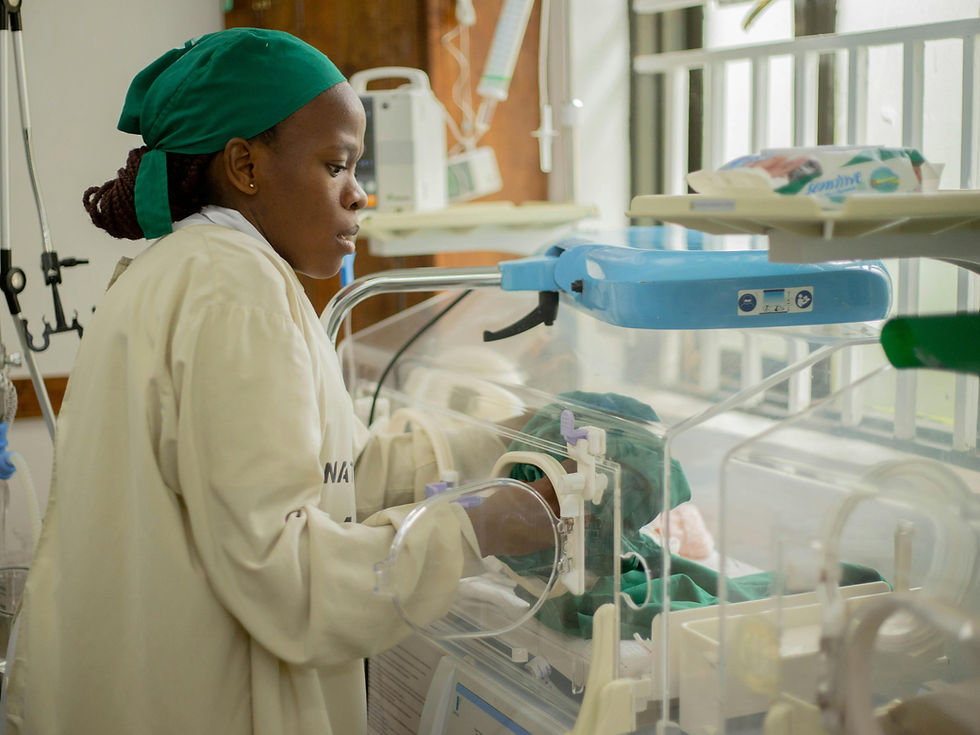
To grow the future health workforce, we must transform learning and accelerate job creation, especially for young women. Photo: Speak Media Uganda
When I was 11 and broke my neck in a car accident, medics airlifted me to a world-class hospital. Triage nurses, medical technicians, and orthopaedic surgeons stabilised my neck and set forth a plan of care. Later, anaesthesiologists joined them through surgery. Countless nurses managed my health, nutrition, and wellbeing round the clock, cracking jokes to lift my spirits. All the while, janitors kept hospital grounds free of infection. My sister Sophie died in the accident. Social workers and physical therapists promoted my full recovery. Though I missed some days of school, I still made the seventh-grade honour roll.
Years later, as a newly deployed Peace Corps volunteer, I travelled the twisting road down Cameroon’s Adamawa Plateau. It was strewn with metal carcasses, vehicles sacrificed to treacherous conditions. I wiped sweat from the blistering heat as it dripped down my nape, touching a familiar scar. I imagined that I might have died in that car accident if it had happened here. As I learned how many families lost a sibling or child for lack of access to basic health care, it carved a wider space in my heart for our shared grief.
Early lessons in equity
Over the next two decades of my public health career, I witnessed the tangled, stubborn roots of health systems inequities. Destinies hinged on whether health services were available, affordable, and met standards of care. At the same time, I also witnessed the resilience of health workers.
I stood side by side with an overworked, under-resourced Cameroonian nurse-midwife as she struggled to communicate with a petite Fulani woman in labour. Transferred from her home village in the English-speaking south to the French-speaking north, that nurse was paid no more than three times the minimum wage. She travelled hours to retrieve her pay cheque, only to sometimes learn that it had not arrived. She suffered in the oppressive heat of a district hospital with spotty electricity and no running water. And yet she returned, day after day, to provide care to her patients.
In Timor-Leste, the sole doctor of a health centre confided in me that in order to have a clean, safe facility, she had to pull water from the well and sweep the grounds herself. In Namibia, dozens of pharmacists from war-torn countries found refuge and stability serving patients in crowded clinics. Despite challenges, I saw how they continued to provide the highest quality of service they could.
In Cameroon, HIV-positive peer educators carried empowering messages to encourage other young people, many abandoned by their families, to take life-saving medicines. In Zanzibar, scores of traditional birth attendants left their beds in the night to accompany labouring mothers to safe delivery. In Sierra Leone, community health workers still mourning their own losses from Ebola made sure that unvaccinated infants were referred for care. I watched them do all of this with quiet heroism, despite nominal pay and facing the great risks they incurred by travelling alone, as women, on dark or flooded roads.
A skilled team of midwives centred me through two pregnancies in the US. When we learned the second was a breech twin pregnancy, a team of anaesthesiologists, surgeons, nurses, paediatricians, and lactation consultants worked together to deliver them safely into the world via C-section. Family nurse practitioners continue to keep us all healthy.
Towards a thriving health workforce
Within complex systems, we must centre health workers. Like all human beings, health workers deserve to thrive. When they thrive, their communities can thrive. Yet too many health systems undervalue their workforce. The World Health Organization (WHO) warns that by 2030, we will face a global shortage of 11 million health workers.
How can we fill this gap? I propose three kinds of solutions: first, grow the future health workforce. Second, accelerate job creation. And third, help the existing health workforce thrive.
To grow the future health workforce, we must transform learning. Too often, education systems divert learning away from primary care in favour of high-tech tertiary care. High tuitions crowd out potential students who are lower-income and intrinsically motivated to serve the most rural and underserved communities.
I imagine a world where underserved youth, especially young women, can access high-quality, affordable schooling in the health professions in rural and resource-poor settings, and where new graduates represent the full diversity of the communities they serve. They build skills to address the social, economic, political, and commercial determinants of health. They practise delivering care locally. They build skills to manage new digital platforms, respond to emerging health threats, and lead inclusively. They benefit from flexible career pathways to balance family and wellbeing. They access continued learning as new challenges emerge and contribute to interdisciplinary teams.
To accelerate job creation, we must recognise that there is no health without a health workforce, and health is our first collective wealth. Too often, health worker jobs are viewed as a cost, when in fact they are an investment that yields up to a 10-to-one return. That is, for every dollar, naira, or rupee spent on a health worker, they will deliver care that is worth 10 times more. If countries do not invest in health jobs, they risk experiencing a tragic mismatch: unemployed or underemployed health graduates and still vacant health posts.
I imagine a world where health jobs flourish because the overall health sector budget is bigger, and where governments make it easier for the private sector to create new health jobs. Local governments are empowered and capacitated to create health jobs that respond to community health priorities. Decent pay is the norm, and health workers can focus on delivering care rather than worrying about their pay cheque. Decent work translates into greater patient trust because health workers do not have to ask for their contribution. Delivering primary care provides a dignified livelihood.
To help the existing health workforce thrive, we must nurture health workers to reach their full potential over the long term. Too often, health workers’ physical and mental health and wellbeing are ignored. Burnout, moral injury, violence, and unsafe conditions deter health workers from staying.
I imagine a world where all health workers are protected at their job, and where practice settings are safe for all. Routine performance management processes promote system-wide improvements and supportive supervision identifies where health workers need more resources. Even with limited resources, health workers are routinely screened for any signs of mental distress. As a nurse recently reminded me, health systems should not be designed where health workers must constantly function heroically, at risk of burnout. We need systems that can retain a healthy workforce for the long term.
Health workers are vessels of healing. Centring people in health systems—both patients and health workers—is a non-negotiable for a healthier world.
The opinions expressed are those of the author and do not necessarily reflect the position of Re:solve Global Health.
Rachel Deussom is a global health systems strategist with over 20 years of experience leading health workforce initiatives with the World Bank (consultant), USAID, the WHO, Gavi, and the Frontline Health Workers Coalition. She is a WomenLift Health fellow, former adjunct faculty at George Washington University, and trained doula. She holds degrees from Georgetown University and the Harvard TH Chan School of Public Health.


